Search This Blog

Wednesday, March 7, 2012

Risk Map of Sales Recording System


PR1: Errors in customer orders due to electronic glitches

This process poses a risk in that 100% of all sales orders are taken electronically via an EDI interface.  This becomes a risk because small problems in the system can have big impacts on customer orders and a system failure would put a halt on the ability of taking customer orders.  Electronic malfunctions are not uncommon and therefore the likelihood that this would happen is moderate but its impacts could be quite high.

PR2: Excessive default on bills by customers

According to the inquiries presented, it is more and more difficult to collect payment on shipped products.  This poses a risk of excessive default by customers.  There seems to be no way to ensure payment prior to sending products to consumers.  This causes a big impact especially on the financial statements where accounts will be inaccurate due to this failure to collect.

PR3: Miscommunication between warehouse and shipping

There seems to be some miscommunication between the warehouse and the shipping dock.  There are times when not all items that need to be shipped to the customer are given to shipping.  Therefore when shipping has to update its files, there is some confusion.  This confusion is further irritated when the items not originally shipped are shipped to customer, as the invoice has already been filed.

PR4: Maintenance of large amounts of accounting records

It was indicated that a large number of accounting records are maintained, even though a number of them contain duplicate information.  This could cause disorganization among the accounting books and records could be ignored or recorded multiple times, causing inaccuracies in the financial statements.

PR5: Lack of supervision over credit verification

It seems that authority over credit verification has been given to sale representatives.  This poses a conflict of interest as sales representatives have the incentive of commissions driving their actions.  This could lead to the approval of customers with bad credit.  However, since sales representatives do not have a sole authority over verification and the accounting department double checks these verifications, this risk has been somewhat mitigated.

PR6: Incomplete shipping orders

As the warehouse employee stated, some orders are sent to shipping incomplete.  This means customer orders are not completely fulfilled.  When partial orders are sent to shipping, this creates confusion for shipping, as well as accounting, because they cannot match the order to what is on the invoice.  However, this risk is decreased due to the fact that the warehouse updates inventory before it is sent to shipping.  That way orders will not be taken if the product is not in stock and partial shipping orders will not be sent.

PR7: Inadequate credit authorization process

This risk seems to be the one creating the most impact.  SDE does not have a clear cut credit authorization process.  Different employees have different ideas of the process.  For example, on employee stated that almost everyone who applies is approved, while another stated that the process is very rigorous.  In addition, there is no set authority over this area.  It is unclear whether this is the task of the sales representatives or the task of the accounting department.  Furthermore, while the company feels that this should be the job of the accounting department, sales representatives have the stake of commission in the task.  This creates a lot of confusion and could result in inconsistent approval methods.  It could also lead to approval of customers with bad credit, especially since the default on bills has increased recently.  It also seems that there is no set control to help mitigate this problem as of yet.


Control Weaknesses and Strengths According to Flowchart Results


Control Weaknesses According to Flowchart Results:

1.      Control environment: Shipping only has a small database that they use to keep track of the good received and removed. They also only need to use the terms stock release and stock records which is very vague and should be more detailed so they know exactly what is going in and out.

2.      Risk assessment: They ship most goods to customers assuming that the credit will be approved since it usually is. If the customer is not approved then they take the risk of wasting time, effort and money to ship it to the customer and sending it back if the customer can’t pay for it. They have the sales department in charge of the credit authorization process which can create a conflict of interest since they work on commission.

3.      Control activities: Anyone can process the order if the sales representative is unavailable. This can cause a delay if they are unfamiliar with the customer’s credit to start processing the order. This can also cause a double order to take place if both the sales representative and someone else are both working on it at the same time. They also could send partially picked orders over to shipping which could cause the order to get lost or misplaced when they have the other available items to add to it later.

4.      Information and communications: There are some miscommunications between the warehouse and shipping department due to over and under shipment of products. This is a simple thing that can be fixed so that over and under shipments of products don't occur again.

5.      Monitoring: There is a delay in the time that it takes the accounting department to send requested information on the needed accounting records and many of the records contain more or less of the same information.


Control Strengths According to Flowchart Results:


1.      Control environment: They have their customer files via EDI, since everything is electronic they will not have a problem of tracking down an order if they hardcopy was lost. This is also more convenient since they can look up which process they are at through the use of technology.

2.      Risk assessment: They have a stringent credit process in place to check for the credits of buyers so that it will minimize the risk of processing the order for customers who will not be able to pay for the items.

3.      Control activities: There are different individuals who experienced in the different processing steps. This allows each person to focus on what they are trained and know how to do best. This also creates more organization so that when there are errors during the process they know which department and who to look for.

4.      Information and communications: Each person that is involved with the processing step is aware of what they are supposed to do. If something is uncertain they can ask the people who are most experienced to get the answers that they need. They update the information in inventory when goods and stock release are picked up so they will know how much they have.

5.      Monitoring: Copies of sales help the business monitor the process of the order from placing it to shipping. They compare sales order to the shipping information to make sure that it matches. To minimize errors the shipping clerk examines the goods and stock release, prepares bill of lading and packing slip and creates shipping notice and files it.

Internal Control Weakness And Strengths According To Interview Results


Internal Control Weaknesses According to Interview Results:

1)      Over and under shipments of products. There seems to be miscommunication between the warehouse and shipping department. When examining the flowchart, SDE does not verify items (orders) before they are shipped.
2)      Large number of accounting records are not recorded on a timely basis. This would mean that there is a high probability that accounting records are misstated due to not being recorded on time. When examining the flowchart to see what is taking so long to update accounting records, transactions have to go through a long process before they can be put into the accounting system. First, an order is sent to the database. The accountant should be able to quickly retrieve order information from this database. Next, SDE checks credit limit and outstanding orders. Third, the company may have to stop an order due to insufficient funding or other issues. Forth, SDE needs to approve the order. The bad thing is that SDE does not verify customer order and shipment according to the flowcharts. This could also contribute to material misstatement, because order amounts could be inaccurate.
3)      SDE refers sales order as a stock release when authorized to remove goods from warehouse. This could also be one of the causes that is contributing to accounting records not being recorded on a timely basis. There should be a sales order right when the customer pays for the product and not an authorization to remove goods from warehouse.
4)      Anyone can perform a credit check. This causes an internal control risk, because only certain individuals should have access to certain things. For example, only certain individuals should be able to perform a credit check, while others are in charge of other business operations.
5)      Credit authorization process. According to the interview results, the company wants the sales department to control this activity to provide more personalized customer service. The problem with this is that the company’s sales department is paid partially commission, which creates a conflict of interest. Members of the sales department cannot effectively work together to provide personal customer service if each member is competing against one another for sales.

Internal Control Strengths According to Interview Results:

1)      Computer can display all electronic merchandise that is available. This allows SDE to quickly analysis what kids of products that are in demand and which are not. Also, the company is able to effectively keep track of all merchandise that is available.
2)      Orders directly go to the customer order database. The company can quickly pull up information about certain customers and can examine what kind of products certain customers purchased.
3)      Company compares the sales order to the shipping notification information. If there is a shipping problem, the company can compare the sales order to the shipping notification system to see if the right sales order was shipped.
4)      Sales order is filed in chronological order. This allows the person in charge of filing sales orders to quickly access certain order information fast if needed. 

Tuesday, March 6, 2012

REAL Modeling Diagram


To document relationships between each REAL attribute, we use cardinals. There are four types of cardinals that we use. Each of them corresponds to each questions asked below:
  1. For each X, what is the minimum value of Y involved?
  2. For each X, what is the maximum value of Y involved?
  3. For each Y, what is the minimum value of X involved?
  4. For each Y, what is the maximum value of X involved?
We document the cardinals in these format:
Attribute 1 -------------------------------------------- Attribute 2
                 (1(Ymin),2(Ymax))        (3(Xmin),4(Xmax))

Each diagram below represent the attributes of REAL model inside each of SDE's department:
(number inside corresponds to table number)


REAL Modeling Table


There are three types of events in a business environment:
  • Operation events are events such as providing goods and services to customers.
  • Information events are events involve recording and maintaining data.
  • Decision events are events that revolve around human decision making.

For SDE, our group are using operation events to document and record SDE's sales order process. There are six steps or checklist that we went through before we document the process using REAL modeling. They are:
  1. We must understand fully SDE business environment and what are its short term and long term business objectives.
  2. We must review the business process based on the interviews that were given to us.
  3. We analyze each process and identify the REAL (Resources, Events, Agents, and Locations) of each process.
  4. We must determine important and significant attributes of each REAL. For example, a customer master database attributes are customer id, customer name, customer address, and customer credit limit.
  5. We must document the relationships among each REAL attribute.
  6. We confirm the accuracy of the REAL model with the client.
Below are our REAL modeling table that document each attributes:

Sales Orders Process REAL Modeling
No. Resources Events Agents Locations
1 Customer orders Receive customer orders on credit EDI interface, customer Digital
2 Printed customer orders Verify customer's credit Sales Representative Sales department
3 Customer's credit limit Make note of approval Sales Representative Sales department
4 Pre-numbered sales order forms Prepare sales order Sales Representative Sales department
5 Copy 1 of sales order & Original customer order Place into filing cabinet Sales Representative Sales department
6 Copy 2 of sales order Send to accounting department Sales Representative Sales department
7 Copy 3 of sales order Send to warehouse Sales Representative Sales department
8 Customer order & sales order Store files in numeric order Sales Representative Closed sales order file
9 Shipping notification & sales order Compare sales order to shipping note Sales Representative Sales department
10 New sales order (stock release) Compare order to stock records Warehouse Employee Warehouse & small database
11 Items & stock release Pick items & make note on stock release Warehouse Employee Warehouse
12 Inventory records Update inventory records to reduce quantity Warehouse Employee Warehouse
13 Items & stock release Send to shipping department (occasionally partial order) Warehouse Employee Warehouse
14 Items & stock release Check for errors Shipping clerk Shipping department
15 Stock release Prepare bill of lading & packing slip Shipping clerk Shipping department
16 Handheld device & customer master database Look up information Shipping clerk Shipping department
17 Bill of lading & packing slip Given to carrier for delivery to customers Shipping clerk, carrier, customer Shipping department
18 Stock release File in chronological order in filing cabinet Shipping clerk Shipping department
19 Stock release Create shipping notice & e-mail to billing and sales department Shipping clerk, computer Shipping department
20 Shipping notification Send to sales department Computer Digital
21 Sales order File in numeric order in cabinet Billing clerk Billing department
22 Shipping notification & sales order Reconcile both to verify accuracy Billing clerk Billing department
23 Sales order Enter into computer program Billing clerk, computer Billing department
24 Customer master table Computer program pulls information Computer Digital
25 Invoice Create invoice & sent electronically to customer Computer, customer Digital
26 Sales order File in chronological order in filing cabinet Billing clerk Billing department
27 Sales orders Pull from filing cabinet & enter information into sales journal & A/R subsidiary ledger Billing supervisor Billing department
28 Sales journal & A/R subsidiary ledger Prepare sales journal voucher & A/R summary Billing supervisor Billing department
29 Sales journal voucher & A/R summary Send to Assistant Controller Billing clerk Billing department
30 Sales journal voucher Update inventory subsidiary ledger Assistant controller AR/GL department
31 Sales journal voucher & A/R subsidiary ledger Check for errors Assistant controller AR/GL department
32 Sales journal voucher & A/R subsidiary ledger Update general ledger inventory & A/R control accounts Assistant controller AR/GL department


Saturday, March 3, 2012

Narrative of System Control Evaluation and Documentation

The following is a narrative of SDE's System Controls and a related key.


Key:
Activities or Processes
Employees
System Strengths / Internal Controls
System Weaknesses, Risks, or Threats


Retail Sales:
A limited amount of merchandise is displayed in the showroom in Torrance. Retail customers may browse through the merchandise but usually obtain help from a sales agent if they wish to purchase an item. The sales agent has access to a computer and POS system. The computer system can display all electronic merchandise that is available.

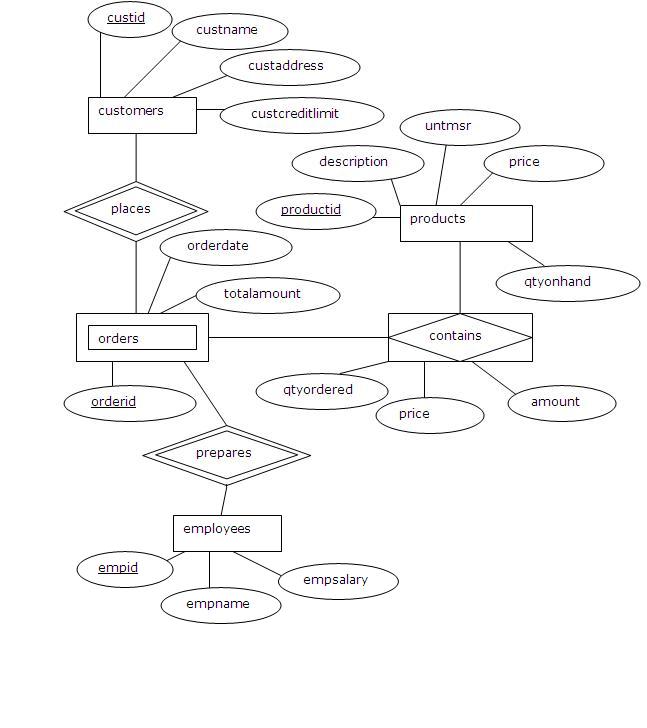
The following flowchart and ER data flow diagram was provided by SDT concerning the general setup of its POS system:
ER diagram of SDT POS sales system
Internet Sales:

Documentation not available.


Trans-Shipper [Business to Business] Sales:
Operations - Jane Humphrey, Director of Operations
PSAAS LLP:  Can you provide me a high-level overview of how you process sales orders?
Jane:  All of our customers are large manufacturers that purchase our products on credit.  We recently changed our system for how customers submit customer orders and I am now pleased to be able to say that we receive 100% of our customer orders electronically via an EDI interface. After receiving a customer order, it is printed and used to check the customer’s credit.  Assuming the credit is approved, which is almost always the case, the goods are then moved from the warehouse to the shipping dock and shipped.  We try to send out the customer invoice as soon as possible to minimize the time between shipping the goods and receiving the customer’s payment.  We also have an accounting department that updates various accounting records, but I am not too familiar with this side of our business.
PSAAS LLP:  Are there any sales order processing issues that keep you up at night?
Jane:  Well, we never used to have problems with receiving payments for shipped products, but after the recent financial crisis it seems like more and more customers are not able to pay for the products they have ordered This is surpising to me as we do have a pretty stringent credit process in place. I am also concerned with over- and under-shipments of products.  There seems to be some miscommunication between the warehouse and the shipping department, but I am not sure what is going on.  While I am sure that accounting is doing things correctly I am also concerned with the time it takes for us to maintain a large number of different accounting records.  It seems like many of these accounting records contain more or less the same information.
PSAAS LLP:  Thank you, I will keep these issues in mind in my review.  Who do you suggest I talk to next?  I would like to talk to at least one individual in each group that is involved in sales order processing, and preferably individuals that perform one or more of the processing steps.
Jane:  Scott Taylor is our most experienced sales representative and he knows the sales process inside and out.  Stephen Smith is our warehouse gang leader; he can point you in the right direction if you need to talk to a record clerk or order filler.  Melissa Foster in shipping has been with us for a very long time and can tell you all you need to know about our shipping processes.  I suggest you get in contact with our controller, Alicia Johnson, to find out more about the accounting processes.  They already know that you are here and they expect to be contacted by you.


Sales - Scott Taylor, Sales Representative
Scott: We receive most customer orders via EDI.  Being that they are electronic they go directly in to our customer order database from which we print hardcopy customer orders.  We then use these hardcopies and pull the customer’s credit information, which includes outstanding orders, accounts receivable, and credit limit, from the customer master table, which is a database that is located in the sales department.  In this step we compare the total of each customer’s current outstanding orders, current accounts receivable, and the new order to each customer’s respective credit limit.  Assuming that the customer has enough credit we then make a note of the approval on the customer order and use the approved customer order to prepare a sales order using prenumbered sales order forms.  One copy of the sale order is placed in the open sale order filing cabinet along with the original customer order.  We also send copies of the sales orders to the warehouse and to accounting.  Later in the process, after the shipping department has shipped the ordered goods, they send us an electronic shipping notification.  We pull the corresponding sales order and customer order from file and compare the sales order to the shipping notification information.  If they match then we store the sales order and the customer order in the closed sales order file in numeric order.
PSAAS LLP: Who is responsible for performing the credit check?
Scott:  We prefer that the sales representative that is the owner of the account verifies the customer’s credit as they know their customer better than anyone else and as they can more quickly resolve any credit issues with the customer.  However, if that person is not available then anyone that has time takes care of it so that we can start processing the order as quickly as possible.


Warehouse - Stephen Smith, Warehouse Gang Leader
PSAAS LLP: Can you please explain the activities you perform in the Warehouse when you receive a new sales order?
Stephen:  After we receive a stock release from the sales department, we compare the items ordered to the stock records to find the location of the items ordered by the customer.  We then pick the items and for every item we pick we make a note on the stock release indicating that the item was picked.   After we have picked all available items on the stock release we send the goods and the stock release over to the shipping department.  Actually, before sending this to the shipping department we first update our own inventory records to reduce the quantity of goods on hand.
PSAAS LLP:  You mentioned that you received a stock release from the sales department, is that the sales order copy from sales?  Also what is the name of the record you use to keep inventory information?
Stephen:  Yes, when we receive the sales order we simply refer to it as a stock release since it authorizes us to pick and remove goods from the warehouse.  As far as the inventory information record, we simply call it the “stock records.”  It is a small database that we use to keep track of goods received and removed from the Warehouse, the location of the goods, etc.
PSAAS LLP: You also said that after you have picked all available items, does that mean that you sometimes send partially picked orders over to shipping?
Stephen:    Yes.


Shipping - Melissa Foster, Shipping Clerk
PSAAS LLP:  Can you please explain the activities you perform in shipping when you receive goods and the stock release from the Warehouse?
Melissa:  After receiving inventory from the warehouse, I first examine the goods and the stock release for errors, I then use the stock release to prepare a bill of lading and packing slip.  To prepare the bill of lading and the packing slip I use a handheld device to look up information from the customer master database located in sales. The bill of lading and the packing slip are then given to the carrier who delivers the goods to the customer.  I then use the stock release to create an electronic shipping notice that I email to the billing department and the sales department.  We finally file the stock release in chronological order in a filing cabinet.

Accounting - Alicia Johnson, Controller
PSAAS LLP:  Can you please provide a high-level overview of the role of the accounting department in sales order processing.
Alicia: The billing department both invoices the customer and updates the sales journal. We also have a  department that posts transactions to the accounts receivable subsidiary ledger and the general ledger.
PSAAS LLP:  Are there any problems in sales order processing that keep you up at night?
Alicia:  I am worried about our credit authorization processes.  The company wants the sales department to control this activity to provide more personalized customer service. However, our sales department is paid partially on commission and this creates a conflict of interest.  
PSAAS LLP:  Thank you, this is something that I will keep in mind during my review.  Who do you suggest I talk to in the billing department and in the AR/GL department?
Alicia:  Sue White in billing should be available today if you have time and I can contact Jim Harris in our “AR/GL department” as you called it.


Accounting - Sue White, Billing Supervisor
PSAAS LLP:  Can you please explain the activities you perform in billing?
Sue:  After the sales order arrives from the sales department we file it in numeric order in our filing cabinet while waiting to receive the shipping notice from the shipping department.  After receiving the shipping notice, we reconcile the sales order and shipping notice information to verify that what was shipped was actually what was ordered.  If the two documents match then we enter the sales order information into a computer program.  The computer program then pulls information from the customer master table to create the invoice that is sent electronically to the customer. The sales order is then filed in chronological order in a filing cabinet, in which we store documents that we have not yet used to update our accounting books.
PSAAS LLP:  Do you do this?
Sue:  Yes, I do this.  However, I do not enter the sales order information for invoice preparation. Ken Weiss, who is my billing specialist, is responsible for doing this.
PSAAS LLP: Can you describe how you update the accounting books?
Sue: I periodically pull sales orders from the filing cabinet and enter this information into the sales journal and the accounts receivable subsidiary ledgers.  I then periodically also prepare a sales journal voucher and an accounts receivable summary based on the information in the sales journal and the accounts receivable subsidiary ledger, respectively.  These two documents are then sent to Jim Harris.


Accounting - Jim Harris, Assistant Controller
PSAAS LLP:  Can you please explain the activities you perform related to sales order processing?
Jim:  I am responsible for keeping track of inventory and maintaining the general ledger.  I update the inventory subsidiary ledger using the information on the sales journal voucher.  I also reconcile the sales journal voucher and the accounts receivable summary to make sure there are no errors before I update the general ledger inventory and accounts receivable control accounts.